


BNSF RAILWAY ...im Modellbau - Geschichte von der BNSF... der Atchison, Topeka and Santa Fe Railway in EN
Geschichte von der BNSF...
„Atchison, Topeka and Santa Fe“ und „ATSF“ leiten hierher weiter. Informationen zum Lied finden Sie unter „On the Atchison, Topeka and the Santa Fe“ . Informationen zum nicht realisierten Flugzeug finden Sie unter Avion de Transport Supersonique Futur.
The Atchison, Topeka and Santa Fe Railway (reporting mark ATSF), oft auch einfach Santa Fe oder AT&SF genannt , war zwischen 1859 und 1996 eine der grössten Eisenbahn-gesellschaften der Klasse 1 in den Vereinigten Staaten.
Die Santa Fe war ein Pionier im intermodalen Güterverkehr ; zeitweise betrieb sie eine Fluggesellschaft, die kurzlebige Santa Fe Skyway, und Schlepper der Santa Fe Railroad. Ihre Buslinie erweiterte den Personenverkehr auf Gebiete, die nicht per Bahn erreichbar waren, und Fähren in der Bucht von San Francisco ermöglichten Reisenden die Weiterreise in den Westen zum Pazifik. Die AT&SF war Gegenstand eines populären Liedes, „ On the Atchison, Topeka and the Santa Fe “ von Harry Warren und Johnny Mercer, das für den Film „ The Harvey Girls “ (1946) geschrieben wurde.
Die Eisenbahn stellte ihren unabhängigen Betrieb offiziell am 31. Dezember 1996 ein, als sie mit der Burlington Northern Railroad zur Burlington Northern and Santa Fe Railway fusionierte.
Geschichte
Atchison, Topeka & Santa Fe Railway
Die Eisenbahn wurde im Februar 1859 gegründet, um die Städte Atchison und Topeka in Kansas sowie Santa Fe in New Mexico zu bedienen. 1873 erreichte die Bahn die Grenze zwischen Kansas und Colorado und 1876 Pueblo in Colorado. Um die Nachfrage nach ihren Dienstleistungen zu steigern, richtete die Eisenbahn Immobilienbüros ein und verkaufte Ackerland aus den Landzuweisungen, die ihr vom Kongress für den Gleisbau gewährt worden waren.
Beim Bau der Eisenbahnstrecke wurden viele Gleise direkt über die Wagenspuren des Santa Fe Trails verlegt. 1869 entstand in Topeka das erste Hauptgebäude der Gesellschaft. Dieses diente gleichzeitig als Bahnhof und Güterbahnhof. Mit der Streckenverlängerung nach Newton, Kansas, im Jahr 1871 entwickelte sich die Eisenbahn zu einem wichtigen Viehtransporteur, um am Ende der texanischen Viehtriebrouten stetige Einnahmen zu sichern.
Das System wurde schließlich durch Zweigstrecken nach Kalifornien, Arizona, Texas, New Mexico, Colorado, Kansas, Missouri, Oklahoma, Louisiana und Illinois erweitert. Arizona und Kalifornien erreichte es durch die Übernahme des westlichen Teils der Atlantic and Pacific Railroad im Jahr 1880. Chicago erreichte es durch die Übernahme der Chicago and St. Louis Railway im Jahr 1887. Bis 1887 war die Hauptstrecke von Chicago nach Los Angeles fertiggestellt, was sie zu einer der wichtigsten Eisenbahnlinien des Landes und zu einer der wenigen machte, die den Mittleren Westen direkt mit dem Golf von Mexiko und dem Pazifik unter einem einzigen Unternehmen verbanden. Die Hauptstrecken bestanden aus:
Atchison, Topeka and Santa Fe Railway | ||
  Das Santa-Fe-System (blau dargestellt) zum Zeitpunkt der Fusion mit BNSF  ATSF 5051, eine EMD SD40-2, führt im August 1983 einen Zug durch Marceline, Missouri. | ||
Übersicht | ||
Hauptsitz | Chicago, Illinois Kansas City, Missouri Los Angeles, California | |
Meldezeichen | ATSF | |
Lokal |
| |
Betriebsdaten | 1859–1996 | |
Nachfolger | ||
Technisches | ||
Spurweite | 4 ft 8+1⁄2 in (1,435 mm) standardmass | |
Länge | 3,115 miles (21,107 km) | |
- Chicago nach Kansas City, nach La Junta, Colorado, nach Los Angeles;
- Emporia, Kansas, nach Oklahoma City, nach Fort Worth, nach Houston;
- Emporia, Kansas, nach Dalies, New Mexico;
- Barstow nach Richmond, Kalifornien (die Valley Division);
- Temple nach Farwell, Texas;
- Von Denver nach La Junta, Colorado;
- Albuquerque, New Mexico, nach El Paso, Texas;
- Von Dallas nach Presidio, Texas; und
- Von Kansas City nach Tulsa.
Die wichtigsten Werkstätten für die Instandhaltung von Lokomotiven in Topeka, Kansas, wurden erstmals in den 1860er Jahren errichtet. Die ursprünglichen Werkstätten wurden 1878 an die Südseite der Seward Avenue verlegt und 1902 erweitert, um die Reparaturkapazität zu verdoppeln. Die Werkstätten in Albuquerque, New Mexico, wurden 1880 erbaut und 1925 wesentlich erweitert. Ein weiterer Werkstattstandort wurde 1886 in San Bernardino, Kalifornien, eingerichtet. Um das Rollmaterial im Bundesstaat Texas instand zu halten, wurde 1899 in Cleburne, Texas, eine vierte grosse Werkstattanlage errichtet.
Physische Auseinandersetzungen führten zu einem zweijährigen bewaffneten Konflikt, der als Royal Gorge Railroad War bekannt wurde. Durch das Eingreifen der Bundesregierung konnte am 2. Februar 1880 eine aussergerichtliche Einigung in Form des sogenannten „Vertrags von Boston“ erzielt werden, in dem der Denver & Rio Grande Railroad gestattet wurde, ihre Strecke fertigzustellen und sie an die Santa Fe Railroad zu verpachten.
Der Bau einer Eisenbahnstrecke durch Kansas und Ost-Colorado war aufgrund der wenigen natürlichen Hindernisse zwar einfach, erwies sich aber aufgrund der geringen Bevölkerungsdichte als wirtschaftlich nahezu unmöglich. Die Eisenbahngesellschaft gründete Immobilienbüros in der Region und förderte die Besiedlung von Kansas auf dem Land, das ihr der Kongress 1863 zugesprochen hatte.
Die Santa Fe Railway erschloss Texas 1886 mit der Gründung der späteren Panhandle and Santa Fe Railway und der Übernahme der Gulf, Colorado and Santa Fe Railway im Jahr 1887. 1891 erreichte die Santa Fe San Francisco durch den Kauf der San Francisco & San Joaquin Valley Railway. 1901 wurde eine Zweigstrecke zum Grand Canyon fertiggestellt. 1906 erwarb die Santa Fe Railway die Anlagen der Southern California Railway. 1911 kam mit dem Kauf der Santa Fe, Prescott and Phoenix Railway eine Zweigstrecke nach Phoenix hinzu.
Erweiterung
Eine Vergleichskarte, die 1921 von der Santa Fe Railroad erstellt wurde und den „Old Santa Fé Trail “ (oben) sowie die AT&SF und ihre Verbindungen (unten) zeigt.
Am 29. März 1955 war die Eisenbahn eines von vielen Unternehmen, die Attraktionen in Disneyland sponserten, und übernahm ein fünfjähriges Sponsoring aller Disneyland-Züge und -Bahnhöfe bis 1974.
1960 kaufte AT&SF die Toledo, Peoria & Western Railroad (TP&W) und veräusserte anschliessend die Hälfte ihrer Anteile an die Pennsylvania Railroad (PRR). Die TP&W verlief geradlinig ostwärts durch Illinois, von der Nähe von Fort Madison, Iowa (Lomax, IL), bis zu einem Anschluss an die PRR bei Effner, Indiana (Grenze Illinois–Indiana). Dadurch entstand eine Umgehungsstrecke um Chicago für den Verkehr zwischen den beiden Linien. Da die TP&W-Strecke nicht mit den von Conrail nach 1976 entwickelten Verkehrsmustern vereinbar war, kaufte AT&SF die andere Hälfte zurück, fusionierte die TP&W 1983 und verkaufte sie 1989 wieder in die Unabhängigkeit.
Versuchter Zusammenschluss der Southern Pacific
AT&SF begann in den 1980er Jahren Fusionsgespräche. Die Southern Pacific Santa Fe Railroad (SPSF) war ein geplanter Zusammenschluss der Muttergesellschaften von Southern Pacific und AT&SF, der am 23. Dezember 1983 angekündigt wurde. Im Zuge des Zusammenschlusses der beiden Unternehmen wurden alle Eisenbahn- und sonstigen Vermögenswerte von Santa Fe Industries und der Southern Pacific Transportation Company in eine Holdinggesellschaft, die Santa Fe–Southern Pacific Corporation, überführt. Die Fusion wurde später von der Interstate Commerce Commission (ICC) mit der Begründung abgelehnt, dass dadurch zu viele Streckenüberschneidungen entstehen würden.
The companies were so confident the merger would be approved that they began repainting locomotives and non-revenue rolling stock in a new unified paint scheme. While Southern Pacific (railroad) was sold off to Rio Grande Industries, all of the SP's real estate holdings were consolidated into a new company, Catellus Development Corporation, making it California's largest private landowner, of which Santa Fe remained the owner. In the early 1980s, gold was discovered on several properties west of Battle Mountain, Nevada along I-80, on ground owned by the Santa Fe Railroad (formerly SP). The Santa Fe Pacific Corporation (a name correlation of Santa Fe and Southern Pacific) was to develop the properties. They were sold to Newmont during 1997 in preparation for the merger with Burlington Northern). Sometime later, Catellus would purchase the Union Pacific Railroad's interest in the Los Angeles Union Passenger Terminal (LAUPT).
Die Unternehmen waren so zuversichtlich, dass die Fusion genehmigt würde, dass sie begannen, Lokomotiven und nicht im Fahrgastbetrieb eingesetztes Rollmaterial in einem neuen, einheitlichen Farbschema neu zu lackieren. Während die Southern Pacific (Eisenbahn) an Rio Grande Industries verkauft wurde, wurden alle Immobilien der SP in einem neuen Unternehmen, der Catellus Development Corporation, zusammengeführt. Dadurch wurde Catellus zum grössten privaten Grundbesitzer Kaliforniens, an dem die Santa Fe weiterhin beteiligt blieb. Anfang der 1980er Jahre wurde auf mehreren Grundstücken westlich von Battle Mountain, Nevada, entlang der Interstate 80, auf Land der Santa Fe Railroad (ehemals SP) Gold entdeckt. Die Santa Fe Pacific Corporation (eine Namenskombination aus Santa Fe und Southern Pacific) sollte die Grundstücke erschliessen. Sie wurden 1997 im Vorfeld der Fusion mit Burlington Northern an Newmont verkauft. Später erwarb Catellus die Anteile der Union Pacific Railroad am Los Angeles Union Passenger Terminal (LAUPT).
Fusion von Burlington Northern
Am 22. September 1995 fusionierte AT&SF mit der Burlington Northern Railroad zur Burlington Northern & Santa Fe Railway (BNSF). Zu den Herausforderungen, die sich aus dem Zusammenschluss der beiden Unternehmen ergaben, zählten die Einrichtung eines gemeinsamen Dispositionsystems, die Gewerkschaftsbildung der nicht gewerkschaftlich organisierten Disponenten von AT&SF und die flächen-deckende Einführung der Zugkennzeichen von AT&SF. Die beiden Bahnstrecken betrieben ihren Betrieb bis zum 31. Dezember 1996 getrennt, als sie offiziell in BNSF umbenannt wurden.
1870 | 1945 | |
Bruttobetriebseinnahmen | 182,580 SD | 528,080,53 USD |
Gesamtlänge der Strecke | 62 miles (100 km) | 13,115 miles (21,107 km) |
beförderte Fracht | 98,920 Tonnen | 59,565,100 Tonnen |
beförderte Passagiere | 33,630 | 11,264,000 |
Lokomotiven im Besitz | 6 | 1,759 |
Besitz von nicht angetriebenen Schienenfahrzeugen | 141 | 81,974 Güterwagen 1,436 Passagierwagen |
Quelle: Santa Fe Railroad (1945), Along Your Way, Rand McNally, Chicago, Illinois. | ||
Umsatz Fracht Tonnenmeilen (Millionen) | ||||||
ATSF/ GC&SF/ P&SF | Oklahoma City-Ada-Atoka | FtWorth & Rio Grande | KCM&O/ KCM&O of Texas | Clinton & Oklahoma Western | New Mexico Central | |
1925 | 13,862 | 14 | 42 | 330 | 2 | 1 |
1933 | 8,712 | 12 | 18 | (incl P&SF) | (incl P&SF) | (incl ATSF) |
1944 | 37,603 | 45 | (incl GC&SF) | |||
1960 | 36,635 | 20 | ||||
1970 | 48,328 | (merged) | ||||
Revenue Passenger-Miles (Millions)msatz in Passagierkilometern (Millionen) | ||||||
ATSF/ GC&SF/ P&SF | Oklahoma City-Ada-Atoka | FtWorth & Rio Grande | KCM&O/ KCM&O of Texas | Clinton & Oklahoma Western | New Mexico Central | |
1925 | 1,410 | 5 | 6 | 8 | 0.1 | 0.1 |
1933 | 555 | 0.1 | 0.8 | (incl P&SF) | (incl P&SF) | (incl ATSF) |
1944 | 6,250 | 0.2 | (incl GC&SF) | |||
1960 | 1,689 | 0 | ||||
1970 | 727 | (merged) | ||||

Die ATSF integrierte Ende des 19. Jahrhunderts den britischen Löwen in ihr Markenzeichen, um die finanzielle Unterstützung des Landes beim Bau der Eisenbahn nach Kalifornien zu würdigen.

D&RGW durch die Royal Gorge im Jahr 1881

Goldanleihe der Atchison, Topeka and Santa Fe Railroad Company, ausgegeben am 1. Oktober 1889

Eine Karte der „Santa Fé Route“ und ihrer Nebenstrecken, wie sie in einer Ausgabe des „Grain Dealers and Shippers Gazetteer“ von 1891 veröffentlicht wurde.

Die Dampflokomotive 5000 „Madame Queen“ (Achsfolge 2-10-4) wartet auf einem Ausweichgleis auf den Bahnübergang mit einem ostwärts fahrenden Zug. Ricardo, New Mexico (März 1943).

Cyrus K. Holliday, erster Präsident von der AT&SF

William Barstow Strong, Präsident 1881–1889
Unternehmensführung
- Cyrus K. Holliday: 1860–1863
- Samuel C. Pomeroy: 1863–1868
- William F. Nast: September 1868
- Henry C. Lord: 1868–1869
- Henry Keyes: 1869–1870
- Ginery Twichell: 1870–1873
- Henry Strong: 1873–1874
- Thomas Nickerson: 1874–1880
- T. Jefferson Coolidge: 1880–1881
- William Barstow Strong: 1881–1889
- Allen Manvel: 1889–1893
- Joseph Reinhart: 1893–1894
- Aldace F. Walker: 1894–1895
- Edward Payson Ripley: 1896–1920
- William Benson Storey: 1920–1933
- Samuel T. Bledsoe: 1933–1939
- Edward J. Engel: 1939–1944
- Fred G. Gurley: 1944–1958
- Ernest S. Marsh: 1958–1967
- John Shedd Reed: 1967–1978
- Lawrence Cena: 1978–1985
- W. John Swartz: 1985–1988
- Mike Haverty: 1989–1991
- Robert Krebs: 1991–1995

Züge der ATSF und der SP Railroad treffen sich Ende der 1980er Jahre am Ausweichgleis Walong auf der Tehachapi-Schleife.
Passenger service
AT&SF was widely known for its passenger train service in the first half of the 20th century. AT&SF introduced many innovations in passenger rail travel, among these the "Pleasure Domes" of the Super Chief (billed as the "...only dome car[s] between Chicago and Los Angeles" when they were introduced in 1951) and the "Big Dome" Lounge cars and double-decker Hi-Level cars of the El Capitan, which entered revenue service in 1954. The railroad was among the first to add dining cars to its passenger trains, a move which began in 1891, following the examples of the Northern Pacific and Union Pacific railroads. The AT&SF offered food on board in a dining car or at one of the many Harvey House restaurants that were strategically located throughout the system.
In general, the same train name was used for both directions of a particular train. The exceptions to this rule included the Chicagoan and Kansas Cityan trains (both names referred to the same service, but the Chicagoan was the eastbound version, while the Kansas Cityan was the westbound version), and the Eastern Express and West Texas Express. All AT&SF trains that terminated in Chicago did so at Dearborn Station. Trains terminating in Los Angeles arrived at AT&SF's La Grande Station until May 1939, when Los Angeles Union Passenger Terminal was opened.
The Santa Fe was the only railroad to run trains from Chicago to California on its own tracks. The railway's extensive network was also home to a number of regional services. These generally couldn't boast of the size or panache of the transcontinental trains, but built up enviable reputations of their own nonetheless. Of these, the Chicago-Texas trains were the most famous and impressive. The San Diegans, which ran from Los Angeles to San Diego, were the most popular and durable, becoming to the Santa Fe what New York City-Philadelphia trains were to the Pennsylvania Railroad. But Santa Fe flyers also served Tulsa, Oklahoma, El Paso, Texas, Phoenix, Arizona (the Hassayampa Flyer), and Denver, Colorado, among other cities not on their main line.
To reach smaller communities, the railroad operated mixed (passenger and freight) trains or gas-electric doodlebug rail cars. The latter were later converted to diesel power, and one pair of Budd Rail Diesel Cars was eventually added. After World War II, Santa Fe Trailways buses replaced most of these lesser trains. These smaller trains generally were not named; only the train numbers were used to differentiate services.
The ubiquitous passenger service inspired the title of the 1946 Academy-Award-winning Harry Warren tune "On the Atchison, Topeka and the Santa Fe." The song was written in 1945 for the film The Harvey Girls, a story about the waitresses of the Fred Harvey Company's restaurants. It was sung in the film by Judy Garland and recorded by many other singers, including Bing Crosby. In the 1970s, the railroad used Crosby's version in a commercial.
 AT&SF passenger train, c. 1895
 A map depicting the "Grand Canyon Route", c. 1901
 AT&SF pass from 1923
 Scene from the filming of The Harvey Girls (1946)
 The San Francisco Chief crossing the Muir Trestle in the 1950s
AT&SF ceased operating passenger trains on May 1, 1971, when it conveyed its remaining trains to Amtrak. These included the Super Chief / El Capitan, the Texas Chief and the San Diegan (though Amtrak reduced the San Diegan from three daily round trips to two). Discontinued were the San Francisco Chief, the ex-Grand Canyon, the Tulsan, and a Denver–La Junta local. ATSF had been more than willing to retain the San Diegan and its famed Chiefs. However, any railroad that opted out of Amtrak would have been required to operate all of its passenger routes until at least 1976. The prospect of having to keep operating its less-successful routes, especially the money-bleeding 23/24 (the former Grand Canyon) led ATSF to get out of passenger service altogether.
Amtrak still runs the Super Chief and San Diegan today as the Southwest Chief and Pacific Surfliner, respectively, although the original routes and equipment have been modified by Amtrak.
Named trains
AT&SF operated the following named trains on regular schedules:
- The Angel: San Francisco, California – Los Angeles, California – San Diego, California (this was the southbound version of the Saint)
- The Angelo: San Angelo, Texas – Fort Worth, Texas (on the GC&SF)
- The Antelope: Oklahoma City, Oklahoma – Kansas City, Missouri
- Atlantic Express: Los Angeles, California – Kansas City, Missouri (this was the eastbound version of the Los Angeles Express).
- California Express: Chicago, Illinois – Kansas City, Missouri – Los Angeles, California
- California Fast Mail: Chicago, Illinois – Los Angeles, California – San Francisco, California
- California Limited: Chicago, Illinois – Los Angeles, California
- California Special: Clovis, New Mexico – Houston, Texas (with through connections to California via the San Francisco Chief at Clovis)
- Cavern: Clovis, New Mexico – Carlsbad, New Mexico (connected with the Scout).
- Centennial State: Denver, Colorado – Chicago, Illinois
- Central Texas Express: Sweetwater, Texas – Lubbock, Texas
- Chicagoan: Kansas City, Missouri – Chicago, Illinois (this was the eastbound version of the Kansas Cityan passenger train).
- Chicago Express: Newton, Kansas – Chicago, Illinois
- Chicago Fast Mail: San Francisco, California – Los Angeles, California – Chicago, Illinois
- Chicago-Kansas City Flyer: Chicago, Illinois – Kansas City, Missouri
- The Chief: Chicago, Illinois – Los Angeles, California
- Eastern Express: Lubbock, Texas – Amarillo, Texas (this was the eastbound version of the West Texas Express).
- El Capitan: Chicago, Illinois – Los Angeles, California
- El Pasoan: El Paso, Texas – Albuquerque, New Mexico
- El Tovar: Los Angeles, California – Chicago, Illinois (via Belen)
- Fargo Fast Mail/Express: Belen, New Mexico – Amarillo, Texas – Kansas City, Missouri – Chicago, Illinois
- Fast Fifteen: Newton, Kansas – Galveston, Texas
- Fast Mail Express: San Francisco, California (via Los Angeles) – Chicago, Illinois
- Golden Gate: Oakland, California – Bakersfield, California, with coordinated connecting bus service to Los Angeles and San Francisco
- Grand Canyon Limited: Chicago, Illinois – Los Angeles, California
- Hassayampa Flyer: Phoenix, Arizona – Ash Fork, Arizona (later Williams Junction, Arizona)
- The Hopi: Los Angeles, California – Chicago, Illinois
- Kansas Cityan: Chicago, Illinois – Kansas City, Missouri (this was the westbound version of the Chicagoan passenger train).
- Kansas City Chief: Kansas City, Missouri – Chicago, Illinois
- Los Angeles Express: Chicago, Illinois – Los Angeles, California (this was the westbound version of the Atlantic Express).
- The Missionary: San Francisco, California – Belen, New Mexico – Amarillo, Texas – Kansas City, Missouri – Chicago, Illinois
- Navajo: Chicago, Illinois – San Francisco, California (via Los Angeles)
- Oil Flyer: Kansas City, Missouri – Tulsa, Oklahoma, with through sleepers to Chicago via other trains
- Overland Limited: Chicago, Illinois – Los Angeles, California
- Phoenix Express: Los Angeles, California – Phoenix, Arizona
- The Ranger: Kansas City, Missouri – Chicago, Illinois
- The Saint: San Diego, California – Los Angeles, California – San Francisco, California (this was the northbound version of the "Angel")
- San Diegan: Los Angeles, California – San Diego, California
- San Francisco Chief: San Francisco, California – Chicago, Illinois
- San Francisco Express: Chicago, Illinois – San Francisco, California (via Los Angeles)
- Santa Fe de Luxe: Chicago, Illinois – Los Angeles, California – San Francisco, California
- Santa Fe Eight: Belen, New Mexico – Amarillo, Texas – Kansas City, Missouri – Chicago, Illinois
- The Scout: Chicago, Illinois – San Francisco, California (via Los Angeles)
- South Plains Express: Sweetwater, Texas – Lubbock, Texas
- Super Chief: Chicago, Illinois – Los Angeles, California
- The Texan: Houston, Texas – New Orleans, Louisiana (on the GC&SF between Galveston and Houston, then via the Missouri Pacific Railroad between Houston and New Orleans).
- Texas Chief: Galveston, Texas (on the GC&SF) – Chicago, Illinois
- Tourist Flyer: Chicago, Illinois – San Francisco, California (via Los Angeles)
- The Tulsan: Tulsa, Oklahoma – Kansas City, Mo. with through coaches to Chicago, Illinois, via other trains (initially the Chicagoan/Kansas Cityan)
- Valley Flyer: Oakland, California – Bakersfield, California
- West Texas Express: Amarillo, Texas – Lubbock, Texas (this was the westbound version of the Eastern Express).
 Super Chief and El Capitan at the Los Angeles Union Passenger Terminal on September 24, 1966
 A promotional brochure for the Santa Fe Railway's Scott Special passenger train
 ATSF 235L - an EMD F7(A) - along with another F7 and a Geep get the road grime washed off at the Engine Service Facility at Argentine Yard in Kansas City, Kansas on the warm day of 24 July 1966.
Photo by Steve Patterson. Quelle: X - QStation - @QStationMedia
ATSF 235L - an EMD F7(A) - along with another F7 and a Geep get the road grime washed off at the Engine Service Facility at Argentine Yard in Kansas City, Kansas on the warm day of 24 July 1966.
Photo by Steve Patterson. Quelle: X - QStation - @QStationMediaSpecial trains
Occasionally, a special train was chartered to make a high-profile run over the Santa Fe's track. These specials were not included in the railroad's regular revenue service lineup, but were intended as one-time (and usually one-way) traversals of the railroad. Some of the more notable specials include:
- Cheney Special: Colton, California – Chicago, Illinois (a one-time train that ran in 1895 on behalf of B.P. Cheney, a director of the Santa Fe).
- Clarke Special: Winslow, Arizona – Chicago, Illinois (a one-time train that ran in 1904 on behalf of Charles W. Clarke, the son of then-Arizona senator William Andrew Clarke).
- David B. Jones Special: Los Angeles, California – Chicago, Illinois, and on to Lake Forest, Illinois (a one-time, record-breaking train that ran between May 5 to 8, 1923, on behalf of the president of the Mineral Point Zinc Company).
- Huntington Special: Argentine, Kansas – Chicago, Illinois (a one-time train that ran in 1899 on behalf of Collis P. Huntington).
- H.P. Lowe Special: Chicago, Illinois – Los Angeles, California (a one-time, record-breaking train that ran in 1903 on behalf of the president of the Engineering Company of America).
- Miss Nellie Bly Special: San Francisco, California – Chicago, Illinois (a one-time, record-breaking train that ran in 1890 on behalf of Nellie Bly, a reporter for the New York World newspaper).
- Peacock Special: Los Angeles, California – Chicago, Illinois (a one-time train that ran in 1900 on behalf of A.R. Peacock, vice-president of the Carnegie Steel and Iron Company).
- Scott Special: Los Angeles, California – Chicago, Illinois (the most well-known of Santa Fe's "specials", also known as the Coyote Special, the Death Valley Coyote, and the Death Valley Scotty Special: a one-time, record-breaking train that ran in 1905, essentially as a publicity stunt).
- Wakarusa Creek Picnic Special: Topeka, Kansas – Pauline, Kansas (a one-time train that took picnickers on a 30-minute trip, at a speed of 14 miles per hour (23 km/h), to celebrate the official opening of the line on April 26, 1869).
Signals
The Santa Fe employed several distinctive wayside and crossing signal styles. In an effort to reduce grade crossing accidents, the Santa Fe was an early user of wigwag signals from the Magnetic Signal Company, beginning in the 1920s. They had several distinct styles that were not commonly seen elsewhere. Model 10's, which had the wigwag motor and banner coming from halfway up the mast with the crossbucks on top, were almost unique to the Santa Fe–the Southern Pacific had a few as well. Upper quadrant Magnetic Flagmen were used extensively on the Santa Fe as well–virtually every small town main street and a number of city streets had their crossings protected by these unique wigwags. Virtually all the wigwags were replaced with modern signals by the turn of the 21st century.
The railroad was also known for its tall "T-2 style" upper quadrant semaphores which provided traffic control on its lines. Again, the vast majority of these had been replaced by the beginning of the 21st century, with fewer than 10 still remaining in use in New Mexico as of 2023.
Paint schemes
Steam locomotives
The Santa Fe operated a large and varied fleet of steam locomotives. In 1899, the company owned 1,036 locomotives. Among them was the 2-10-2 "Santa Fe", originally built for the railroad by Baldwin Locomotive Works in 1903. The railroad would ultimately end up with the largest fleet of
 AT&SF#1129, a 1902 Baldwin 2-6-2 Prairie locomotive, preserved at Las Vegas, New Mexico, since 1956
them, at over 300. Aside from the 2-10-2, Santa Fe rostered virtually every type of steam locomotive imaginable, including 4-4-2 Atlantics, 2-6-0 Moguls, 2-8-0 Consolidations, 2-8-2 Mikados, 2-10-0 Decapods, 2-6-2 Prairies, 4-8-4 Northerns, 4-6-4 Hudsons, 4-6-2 Pacifics, 4-8-2 Mountains, 2-8-4 Berkshires, and 2-10-4 Texas. The railroad also operated a fleet of heavy articulated Mallet locomotives, including 1158 class 2-6-6-2s, 2-8-8-0s, 2-10-10-2s, 2-8-8-2s, and the rare 4-4-6-2. The railroad retired its last steam locomotive in 1959.
During the twentieth century, all but one of these was painted black, with white unit numbers on the sand domes and three sides of the tender. Cab sides were lettered "AT&SF", also in white. The subsidiary Gulf, Colorado and Santa Fe often painted all or part of the smokebox (between the boiler and the headlight) white or silver. In 1940, the circle and cross emblem was applied to the tenders of a few passenger locomotives, but these were all later painted over. After World War II, "Santa Fe" appeared on tender sides of mainline road locomotives in white, above the unit number. Locomotives were delivered from Baldwin with white paint on the wheel rims, but the road did not repaint these "whitewalls" after shopping the locomotives. After World War II, side rods and valve gear were painted chrome yellow. For a short time, Pacific types 1369 and 1376 were semi-streamlined for "Valley Flyer" service, with a unique paint scheme in colors similar to those used on the new passenger diesels. Unique was the two-tone light blue over royal blue scheme of streamlined Hudson type 3460.
 BNSF-PSAP grain train
Diesel locomotives
Passenger
Santa Fe's first set of diesel-electric passenger locomotives was placed in service on the Super Chief in 1936, and consisted of a pair of blunt-nosed units (EMC 1800 hp B-B) designated as Nos. 1 and 1A. The upper portion of the sides and ends of the units were painted gold, while the lower section was a dark olive green color; an olive stripe also ran along the sides and widened as it crossed the front of the locomotive. Riveted to the sides of the units were metal plaques bearing a large "Indian Head" logo, which owed its origin to the 1926 Chief "drumhead" logo.
 EMC 1800 hp B-B in the original Golden Olive scheme (1935) - The two units of Atchison, Topeka and Santa Fe Railway Diesel locomotive #1, photographed in Chicago on August 31, 1935.
"Super Chief" was emblazoned on a plaque located on the front. The rooftop was light slate gray, rimmed by a red pinstripe. This unique combination of colors was called the Golden Olive paint scheme. Before entering service, Sterling McDonald's General Motors Styling Department augmented the look with the addition of red and blue striping along both the sides and ends of the units in order to enhance their appearance.
 EMC E1 in Warbonnet (1938) - A 1938 publicity photo of Santa Fe's Golden Gate passenger train pulled by ATSF E1 no. 8, which was used exclusively for Golden Gate service
In a little over a year, the EMC E1 (a new and improved streamlined locomotive) would be pulling the Super Chief and other passenger consists, resplendent in the now-famous Warbonnet paint scheme devised by Leland Knickerbocker of the GM Art and Color Section. Its design was protected under a U.S. design patent, granted on November 9, 1937. It is reminiscent of a Native American ceremonial head-dress. The scheme consisted of a red "bonnet" that wrapped around the front of the unit and was bordered by a yellow stripe and black pinstripe. The extent of the bonnet varied according to the
locomotive model and was largely determined by the shape and length of the car body. The remainder of the unit was either painted silver or was composed of stainless-steel panels.
All units wore a nose emblem consisting of an elongated yellow "Circle and Cross" emblem with integral "tabs" on the nose and the sides, outlined and accented with black pinstripes, with variances according to the locomotive model. "SANTA FE" was displayed on the horizontal limb of the cross in black, Art Deco-style lettering. This emblem has come to be known as the "cigar band" due to its uncanny resemblance to the same. On all but the "Erie-built" units (which were essentially run as a demonstrator set), GE U28CG, GE U30CG, and FP45 units, a three-part yellow and black stripe ran up the nose behind the band.
A "Circle and Cross" motif (consisting of a yellow field, with red quadrants, outlined in black) was painted around the side windows on "as-delivered" E1 units. Similar designs were added to E3s, E6s, the DL109/110 locomotive set, and ATSF 1A after it was rebuilt and repainted. The sides of the units typically bore the words "SANTA FE" in black, 5"– or 9"–high extra extended Railroad Roman letters, as well as the "Indian Head" logo, with a few notable exceptions.
ATSF 1 | Yes | Yes* | Yes | No | 1937 | "Circle and Cross" added to No. 1 after rebuild in May 1938 |
EMC E1, E3, & E6 | Yes* | Yes | Yes | No | 1937 | "Indian Head" added to B units at a later date |
ALCO DL109/110 | Yes* | Yes | Yes | No | 1941 | No "Indian Head" on B unit |
EMD FT | Yes* | No | Yes | No | 1945 | "Indian Head" added to B units at a later date |
ALCO PA / PB | Yes* | No | Yes | No | 1946 | "Indian Head" added to B units at a later date |
EMD F3 | Yes* | No | Yes | No | 1946 | "Indian Head" on B units only |
FM Erie-built | Yes* | No | Yes* | No | 1947 | "Indian Head" and "SANTA FE" on A units only |
EMD F7 | Yes* | No | Yes* | No | 1949 | "Indian Head" on B units only; "SANTA FE" added in 1954 |
EMD E8 | Yes* | No | No | No | 1952 | "Indian Head" on B units only |
GE U28CG | No | No | No | Yes | 1966 | "Santa Fe" logotype in large, red "billboard"-style letters |
GE U30CG | No | No | Yes* | No | 1967 | 5"–high non-extended "SANTA FE" letters |
EMD FP45 | No | No | Yes* | No | 1967 | 9"–high "SANTA FE" letters |
Source: Pelouze, Richard W. (1997). Trademarks of the Santa Fe Railway. The Santa Fe Railway Historical and Modeling Society, Inc., Highlands Ranch, Colorado, pp. 47–50. | ||||||
In later years, Santa Fe adapted the scheme to its gas-electric "doodlebug" units. The standard for all of Santa Fe's passenger locomotives, the Warbonnet is considered by many to be the most-recognized corporate logo in the railroad industry. Early after Amtrak's inception in 1971, Santa Fe embarked on a program to repaint the red bonnet on its F units that were still engaged in hauling passenger consists with yellow (also called Yellowbonnets) or dark blue (nicknamed Bluebonnets), as it no longer wanted to project the image of a passenger carrier.
 Santa Fe#103, an EMD FT unit decorated in the "Cat Whiskers" scheme, receives service during World War II.
Freight
Diesels used as switchers between 1935 and 1960 were painted black, with just a thin white or silver horizontal accent stripe (the sills were painted similarly). The letters "A.T.& S.F." were applied in a small font centered on the sides of the unit, as was the standard blue and white "Santa Fe" box logo. After World War II, diagonal white or silver stripes were added to the ends and cab sides to increase the visibility at grade crossings (typically referred to as the Zebra Stripe scheme). "A.T.& S.F." was now placed along the sides of the unit just above the accent stripe, with the
blue and white "Santa Fe" box logo below. Due to the lack of abundant water sources in the American desert, the Santa Fe Railway was among the first railroads to receive large numbers of streamlined diesel locomotives for use in freight service, in the form of the EMD FT. or the first group of FTs, delivered between December 1940 and March 943 (#100–#119), the railroad selected a color scheme consisting of dark blue accented by a pale yellow stripe up the nose, and pale yellow ighlights around the cab and along the mesh and framing of openings in the sides of the engine compartment; a thin red stripe separated the blue areas from the yellow.
The words SANTA FE were applied in yellow in a 5"–high extended font, and centered on the nose was the "Santa Fe" box logo (initially consisting of a blue cross, circle, and square painted on a solid bronze sheet, but subsequently changed to baked steel sheets painted bronze with the blue identifying elements applied on top). Three thin, pale yellow stripes (known as Cat Whiskers) extended from the nose logo around the cab sides. In January, 1951, Santa Fe revised the scheme to consist of three yellow stripes running up the nose, with
 A museum restoration of Kennecott Copper Corporation #103 (an Alco model RS-2) now bears the #2098 and the ATSF Zebra Stripe paint scheme.
the addition of a blue and yellow Cigar Band (similar in size and shape to that applied to passenger units); the blue background and elongated yellow "SANTA FE" lettering were retained.
The years 1960 to 1972 saw non-streamlined freight locomotives sporting the "Billboard" color scheme (sometimes referred to as the "Bookends" or "Pinstripe" scheme), where the units were predominantly dark blue with yellow ends and trim, with a single yellow accent pinstripe. The words "Santa Fe" were applied in yellow in large bold serif letters (logotype) to the sides of the locomotive below the accent stripe (save for yard switchers which displayed the "SANTA FE" in small yellow letters above the accent stripe, somewhat akin to the Zebra Stripe arrangement).
From 1972 to 1996, and even on into the BNSF era, the company adopted a new paint scheme often known among railfans as the "Freightbonnet" or "Yellowbonnet", which placed more yellow on the locomotives (reminiscent of the company's retired Warbonnet scheme); the goal again was to ensure higher visibility at grade crossings. The truck assemblies, previously colored black, now received silver paint.
In 1965, the road took delivery of ten GE U28CG dual-service road switcher locomotives equally suited to passenger or fast freight service. These wore a variation of the "Warbonnet" scheme in which the black and yellow separating stripes disappeared. The "Santa Fe" name was emblazoned on the sides in large black letters, using the same stencils used on freight engines; these were soon repainted in red. In 1989, Santa Fe resurrected this version of the "Warbonnet"
 Santa Fe #2378, an Alco S-2 switcher in the Billboard scheme (1966)
scheme and applied it to two SDFP45 units, #5992 and #5998. The units were re-designated as #101 and #102 and reentered service on July 4, 1989, as part of the new "Super Fleet" campaign (the first Santa Fe units to be so decorated for freight service). The six remaining FP45 units were thereafter similarly repainted and renumbered. From that point forward, most new locomotives wore red and silver, and many retained this scheme after the Burlington Northern Santa Fe merger, some with "BNSF" displayed across their sides.
For the initial deliveries of factory-new "Super Fleet" equipment, Santa Fe took delivery of the EMD GP60M and General Electric B40-8W which made the Santa Fe the only US Class I railroad to operate new 4-axle (B-B) freight locomotives equipped with the North American Safety Cab intended for high-speed intermodal service.
Several experimental and commemorative paint schemes emerged during the Santa Fe's diesel era. One combination was developed and partially implemented in anticipation of a merger between the parent companies of the Santa Fe and Southern Pacific (SP) railroads in 1984. The red, yellow, and black paint scheme with large yellow block letters on the sides and ends of the units of the proposed Southern Pacific Santa Fe Railroad (SPSF) has come to be somewhat derisively known among railfans as the Kodachrome livery, due to the similarity in colors to the boxes containing slide film sold by the Eastman Kodak Company under the same name. Santa Fe units repainted in this scheme were labeled "SF", Southern Pacific units "SP", and some(presumably new) units wore the letters "SPSF". After the ICC's denial of the merger, railfans joked that SPSF really stood for "Shouldn't Paint So Fast."
Paint schemes of the AT&SF locomotives
 ATSF 108 at Southern California Railway Museum, repainted into its original colors - 3 June 2018
 Santa Fe #681 in Sealy Texas, June 2001 - Own work - 1 June 2001
 Santa Fe #98 (originally #108), an EMD FP45 decked out in Warbonnet colors, including the traditional "cigar band" nose emblem - EMD FP45 locomotive at the Orange Empire Railway Museum in Perris, California - 28 August 2005
 EMD SD45 #5338 SF. Modell von R. Britt
 ATSF 9542 in Kodachrome leads other locomotives in Freightbonnet (1990) - from San Jose, California Republic - ATSF Downhhill Caliente Aug 90xRP - 2 August 2012
 Warbonnet roof details - from San Jose, CA, The Republic of California - 42 Richmond yd - 01.pr 1969
 Der „Super Chief“ beim Nachtanken in Albuquerque, März 1943
ATSF San Diegan EMD F7 (1968), displaying the "SANTA FE" in black Railroad Roman letters along each side - from San Jose, CA, The Republic of California - 43C - San Diego, April 1968
 AT&SF No. 870, a 1906-built 2-8-0 from Burnham, Williams & Co. on static display at a park in Santa Fe Springs - 7 June 2010
Preserved locomotives
While most of the Santa Fe's steam locomotives were retired and sold for scrap, over fifty were saved and donated to various parks and museums, a handful of which have either been restored to operating condition or are pending future restoration.
Some of the more notable locomotives include:
- 5 (0-4-0), located at the California State Railroad Museum in Sacramento, California.
- 132 (2-8-0), Built by Baldwin in 1880 and located at the Kansas Museum of History in Topeka. Named for Cyrus K. Holliday. Was used often by the Santa Fe for promotions and special events until it was donated to the Kansas State Historical Society in 1977. It is the second oldest locomotive from the Santa Fe that is preserved close to its original appearance.
- 643 (2-8-0), Originally built by Hinkley Locomotive Works in 1879 as #73 with a 4-4-0 arrangement. The oldest preserved locomotive of the Santa Fe, although not as originally configured. It was converted by the railroad to a 2-8-0 configuration following an accident in 1897. It had several upgrades over the years while working on the Gulf Division. It was formerly located at the then-new Oklahoma State Fairgrounds, following its donation from the Santa Fe to the people of Oklahoma in 1953. The locomotive was relocated again in 2015 to the Oklahoma Railway Museum in Oklahoma City, where it received a badly needed cleaning and thorough cosmetic restoration, and is currently on display.
- 769 (2-8-0), located at the Old Coal Mine Museum in Madrid, New Mexico. It is waiting to be moved to the Santa Fe Southern Railway in Santa Fe for future restoration to operating condition.
- 870 (2-8-0), located at Heritage Park in Santa Fe Springs, California.
- 940 (2-10-2), located at the Union depot in Bartlesville, Oklahoma. It is the only surviving steam locomotive from the Santa Fe with a 2-10-2 wheel arrangement.
- 1010 (2-6-2), located at the California State Railroad Museum in Sacramento, California.
- 1129 (2-6-2), located at Las Vegas, New Mexico.
- 1316 (4-6-2), formerly located at Fort Concho, Texas: the sole survivor of the 1309 class was restored to operating condition by the Texas State Railroad in the early 1980s as its No. 500. It is currently displayed at Palestine for another restoration for future excursion service.
- 2913 (4-8-4), located in Riverview Park at Fort Madison, Iowa.
- 2926 (4-8-4), formerly located in Coronado Park in Albuquerque, New Mexico. This locomotive had been undergoing restoration for operational purposes by the New Mexico Steam Locomotive and Rail Historical Society, which has expended 114,000 man-hours and $1,700,000 in donated funds on its restoration since 2002. It was restored on July 2021. Performed her first mainline travel on September 30, 2023.
- 3415 (4-6-2), formerly located at Eisenhower Park in Abilene, Kansas, until it was acquired by the Abilene and Smoky Valley Railroad and has been restored for excursion service since 2009. The locomotive is expected to be taken out of service for a 15 year boiler inspection later in 2023.
- 3416 (4-6-2), currently preserved at Great Bend, Kansas.
- 3417 (4-6-2), formerly preserved at Hulen Park, in Cleburne, Texas.
- 3423 (4-6-2), located at the Railroad & Heritage Museum in Temple Texas, it is currently preserved.
- 3424 (4-6-2), Preserved in Kinsley, Kansas.
- 3450 (4-6-4), the sole survivor of the 3450 class, this locomotive is the gateway of the RailGiants Train Museum in Pomona, California.
- 3463 (4-6-4), the sole survivor of the 3460 class, this locomotive is located at the Kansas Expocentre in Topeka, Kansas, waiting for future restoration.
- 3751 (4-8-4), the Santa Fe's and Baldwin's very first 4-8-4, was once on display at Viaduct Park near the AT&SF depot in San Bernardino, California. The locomotive was moved out of the park in 1986 to be restored and, after almost 5 years later, No. 3751 made its first run on a 4-day trip from Los Angeles to Bakersfield and return in December 1991. This trip marked the beginning of No. 3751's career in excursion service. Beginning in 2017, 3751 underwent a federally required 15-year overhaul until September 2022. On the same month, it's federally required 15-year overhaul was complete, and after that, it attended the Amtrak Track Safety Event in Fullerton, California, on September 24, 2022, and September 25, 2022.
- 3759 (4-8-4): This locomotive is known for pulling the "Farewell to Steam Excursion" for the Santa Fe in 1955 before it was donated to the City of Kingman, Arizona, where it is currently on static display. It was almost acquired by the Grand Canyon Railway in the early 1990s.
- 3768 (4-8-4), after retiring in 1958, it was donated to the city of Wichita, Kansas, where it is currently preserved at the Great Plains Museum of Transportation.
- 5000 Madame Queen (2-10-4), the second-oldest preserved steam locomotive with a 2-10-4 wheel arrangement, Madame Queen is located in Amarillo, Texas, awaiting possible relocation elsewhere.
- 5011 (2-10-4), the first of the 5011 class, is on static display at the National Museum of Transportation in St. Louis, Missouri.
- 5017 (2-10-4), located at the National Railroad Museum in Green Bay, Wisconsin.
- 9005 (0-6-0), located in the historic train depot in Clovis, New Mexico.
Ferry service
Santa Fe maintained and operated a fleet of three passenger ferry boats (the San Pablo, the San Pedro, and the Ocean Wave) that connected Richmond, California, with San Francisco by water. The ships traveled the eight miles between the San Francisco Ferry Terminal and the railroad's Point Richmond terminal across San Francisco Bay. The service was originally established as a continuation of the company's named passenger train runs such as the Angel and the Saint. The larger two ships (the San Pablo and the San Pedro) carried Fred Harvey Company dining facilities.
Rival SP owned the world's largest ferry fleet (which was subsidized by other railroad activities), at its peak carrying 40 million passengers and 60 million vehicles annually aboard 43 vessels. Santa Fe discontinued ferry service in 1933 due to the effects of the Great Depression and routed their trains to Southern Pacific's ferry terminal in Oakland. The San Francisco–Oakland Bay Bridge opened in 1936, initiating a slow decline in demand for SP's ferry service, which was eventually discontinued c. 1958; starting in 1938, SF-bound passengers could board buses across the bridge at the Santa Fe Oakland depot (located in Emeryville).
 BALDWIN 4-8-4 Northern #3751 ATSF - Modell: BLI Hybrid P2 - R. Britt
Super Chief in New Mexico
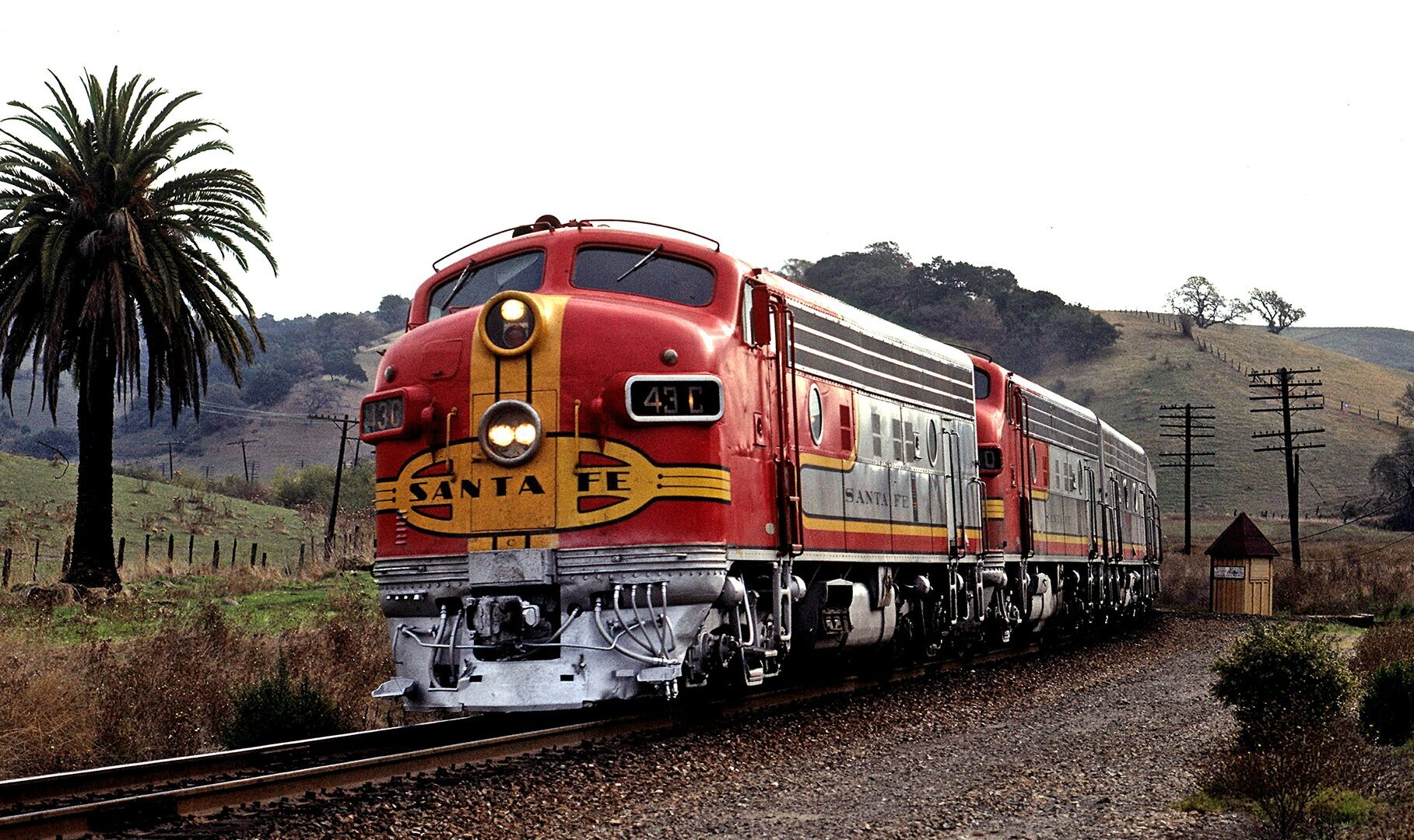
ATSF San Diegan, in classic Warbonnet color scheme, near Miramar, 1973
Wikipedia:
Update: 03. + 04.03.2024
Quelle: https://en.wikipedia.org/wiki/Atchison,_Topeka_and_Santa_Fe_Railway
Quelle: https://en.wikipedia.org/wiki/Atchison,_Topeka_and_Santa_Fe_Railway