


BNSF RAILWAY ...im Modellbau - Geschichte von der BNSF... the Gulf of Mexico in EN
Geschichte von der BNSF...
The Gulf of Mexico (Spanish: Golfo de México) is an oceanic basin and a marginal sea of the Atlantic Ocean, mostly surrounded by the North American continent. It is bounded on the northeast, north, and northwest by the Gulf Coast of the United States; on the southwest and south by the Mexican states of Tamaulipas, Veracruz, Tabasco, Campeche, Yucatán, and Quintana Roo; and on the southeast by Cuba.
The Gulf of Mexico basin is roughly oval and is about 810 nautical miles (1,500 kilometres; 930 miles) wide. Its floor consists of sedimentary rocks and recent sediments. It is connected to part of the Atlantic Ocean through the Straits of Florida between the U.S. and Cuba, and with the Caribbean Sea via the Yucatán Channel between Mexico and Cuba. Because of its narrow connection to the Atlantic Ocean, the gulf has very small tidal ranges. Moisture from the Gulf of Mexico also contributes to weather across the United States, including severe weather in Tornado Alley.
The size of the gulf basin is about 1.6 million square kilometres (620,000 square miles). Almost half of the basin consists of shallow continental shelf waters. The volume of water in the basin is roughly 2.4 million cubic kilometres (580 thousand cubic miles). The gulf is one of the most important offshore petroleum production regions in the world, making up 14% of the total production for the United States.
Name
As with the name of Mexico, the gulf's name is associated with the ethnonym Mexica, which refers to the Nahuatl-speaking people of the Valley of Mexico better known as the Aztecs. In Aztec religion, the gulf was called Chalchiuhtlicueyecatl, or 'House of Chalchiuhtlicue', after the deity of the seas. Believing that the sea and sky merged beyond the horizon, they called the seas ilhuicaatl, meaning 'sky water', contrasting them with finite, landlocked bodies of water, such as lakes. The Maya civilization, which used the gulf as a major trade route, likely called the gulf nahá, meaning 'great water'.
Up to 1530, European maps depicted the gulf, though left it unlabeled. Hernán Cortés called it "Sea of the North" (Spanish: Mar del Norte) in his dispatches, while other Spanish explorers called it the "Gulf of Florida" (Golfo de Florida) or "Gulf of Cortés" (Golfo de Cortés). A 1584 map by Abraham Ortelius also labeled it as the "Sea of the North" (Mare de Nort). Other early European maps called it the "Gulf of St. Michael" (Latin: Sinus S. Michaelis), "Gulf of Yucatán" (Golfo de Iucatan), "Yucatán Sea" (Mare Iuchatanicum), "Great Antillean Gulf" (Sinus Magnus Antillarum), "Cathayan Sea" (Mare Cathaynum), or "Gulf of New Spain" (Spanish: Golfo de Nueva España). At one
Gulf of Mexcio | |
 Gulf of Mexico coastline near Galveston, Texas Gulf of Mexico coastline near Galveston, Texas | |
 Bathymetry of the Gulf of Mexico Bathymetry of the Gulf of Mexico | |
Location | American Mediterranean Sea |
Coordinates | 25°N 90°W |
River Sources | Rio Grande, Mississippi River, Mobile River, Panuco River, Jamapa River, Pascagoula River, Tecolutla River, Usumacinta River, Apalachicola river |
Ocean/sea sorces | Atlantic Ocean, Caribbean Sea |
Basin countries | Cuba Mexico United States of America |
Max. width | 1,500 km (932.06 mi) |
Surface area | 1,550,000 km2 (600,000 sq mi) |
Average depth | 1,615 metres (5,299 ft) |
Max. depth | 3,750 to 4,384 metres (12,303 to 14,383 ft) |
Settlements | Veracruz, Houston, New Orleans, Corpus Christi, Tampa, Havana, Southwest Florida, Mobile, Gulfport, Tampico, Key West, Cancún, Ciudad del Carmen, Coatzacoalcos, Panama City |
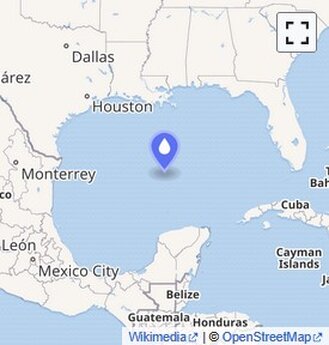 Interactive map of Gulf of Mexico | |
 English nautical chart from 1700 labels the body of water "the Great Bay of Mexico"
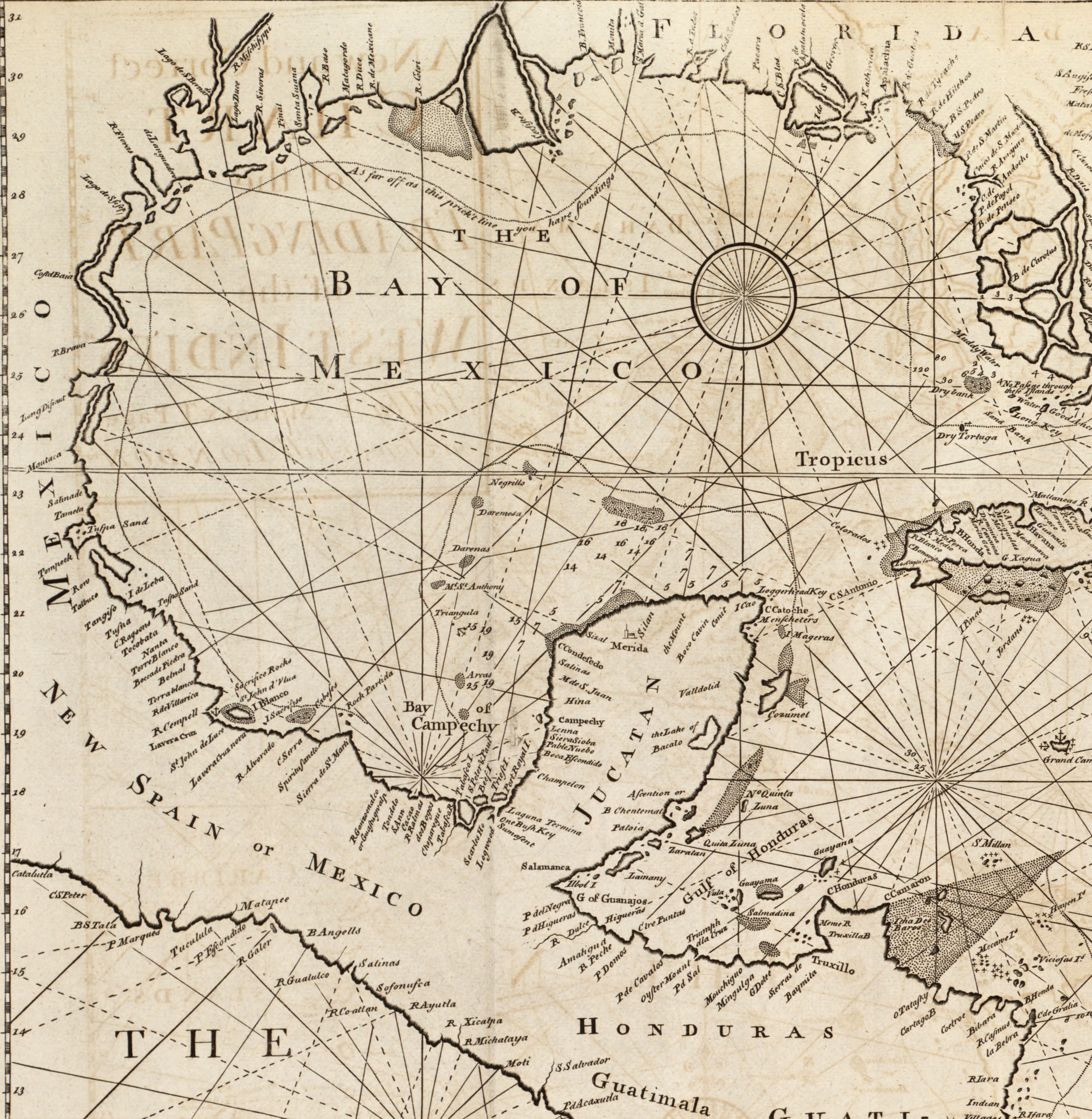 English nautical chart dated 1775 labels "the Bay of Mexico", now glossing "Mexico" as an alternative name for New Spain
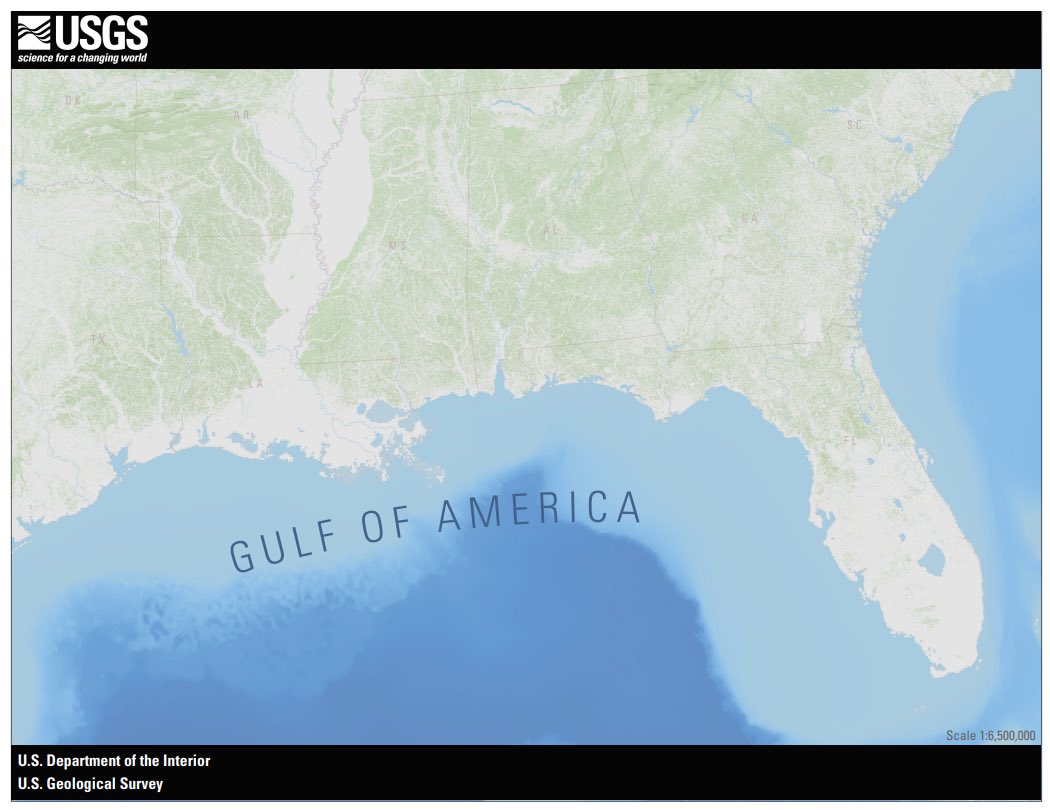 U.S. Geological Survey map, February 2025
 The Harbor at Galveston, by Verner Moore White (1863–1923)
point, New Spain encircled the gulf, with the Spanish Main extending into what later became Mexico and the southeastern United States.
The name "Gulf of Mexico" (Spanish: golfo de México; French: golphe du Mexique, later golfe du Mexique) first appeared on a world map in 1550 and a historical account in 1552. As with other large bodies of water, Europeans named the gulf after Mexico, land of the Mexica, because mariners needed to cross the gulf to reach that destination. This name has been the most common name since the mid-17th century, when it was still considered a Spanish sea. French Jesuits used this name as early as 1672. In the 18th century, Spanish admiralty charts similarly labeled the gulf as "Mexican Cove" or "Mexican Sound" (Ensenada Mexicana or Seno Mexicano). Until the Republic of Texas broke away from Mexico in 1836, Mexico's coastal boundary extended eastward along the gulf to present-day Louisiana.
Among the other languages of Mexico, the gulf is known as Ayollohco Mexihco in Nahuatl, u golfoil México in Yucatec Maya, and golfo yu'un México in Tzotzil. Although there is no formal protocol on the general naming of international waters, Gulf of Mexico is officially recognized by the International Hydrographic Organization, which seeks to standardize the names of international maritime features for certain purposes and counts all three countries adjacent to the gulf as member states.
In a January 2025 executive order, United States president Donald Trump directed federal agencies to adopt the name "Gulf of America" for the waters bounded by the U.S. Some major online map platforms and several U.S.-based media outlets voluntarily adopted the change, but it also stoked controversy, with Mexican president Claudia Sheinbaum and others objecting to the declaration. A February 2025 poll by Marquette University found that, among 1,018 respondents across the U.S., 71% opposed renaming the Gulf of Mexico and 29% supported the name change.
Extent
The International Hydrographic Organization publication Limits of Oceans and Seas defines the southeast limit of the Gulf of Mexico as:
A line joining Cape Catoche Light (21°37′N 87°04′W) with the Light on Cape San Antonio in Cuba, through this island to the meridian of 83°W and to the Northward along this meridian to the latitude of the South point of the Dry Tortugas (24°35′N), along this parallel Eastward to Rebecca Shoal (82°35′W) thence through the shoals and Florida Keys to the mainland at the eastern end of Florida Bay and all the narrow waters between the Dry Tortugas and the mainland being considered to be within the Gulf.
Population
The Gulf Coast of the United States, or Gulf Coastal Region, is composed of parts of the five U.S. states facing the Gulf. In 2016, the total population of the region was 15.8 million people. Major cities along the coast include Houston, Texas; New Orleans, Louisiana; Mobile, Alabama; and Pensacola, Florida.
The six Mexican states that face the gulf have a total population of 19.1 million people.
Three provinces of northwest Cuba, including Havana, border on the gulf, have a combined population of 3,211,000.
Geology
The Gulf of Mexico took shape about 300 million years ago as a result of plate tectonics. The consensus among geologists is that before the late Triassic, the Gulf of Mexico did not exist. Before the late Triassic, the area consisted of dry land, which included continental crust that now underlies Yucatán, within the middle of the supercontinent Pangaea. This land lay south of a continuous mountain range that extended from north-central Mexico, through the Marathon Uplift in west Texas and the Ouachita Mountains of Oklahoma, and to Alabama where it linked directly to the Appalachian Mountains. It was created by the collision of continental plates that formed Pangaea. As interpreted by Roy Van Arsdale and Randel T. Cox, this mountain range was breached in the late Cretaceous by the formation of the Mississippi Embayment.
 Ship and oil rigs in the Gulf
The rifting that created the basin was associated with zones of weakness within Pangaea, including sutures where the Laurentia, South American, and African plates collided to create it. Firstly, there was a late Triassic–early Jurassic phase of rifting during which rift valleys formed and filled with continental red beds. Secondly, the continental crust was stretched and
thinned as rifting progressed through the early and middle Jurassic times. This thinning created a broad zone of transitional crust, which displays modest and uneven thinning with block faulting and a broad zone of uniformly thinned transitional crust, which is half the typical 40 km (25-mile) thickness of continental crust. At this time, rifting first created a connection to the Pacific Ocean across central Mexico and later eastwards to the Atlantic Ocean. This flooded the opening basin to create an enclosed marginal sea. The subsiding transitional crust was blanketed by the widespread deposition of Louann Salt and associated anhydrite evaporites. During the late Jurassic, continued rifting widened the basin and progressed to the point that seafloor spreading and formation of oceanic crust occurred. At this point, sufficient circulation with the Atlantic Ocean was established that the deposition of Louann Salt ceased. Seafloor spreading stopped at the end of the Jurassic, about 145–150 million years ago.
During the late Jurassic through early Cretaceous, the basin experienced a period of cooling and subsidence of the crust underlying it. The subsidence resulted from crustal stretching, cooling, and loading. Initially, the crustal stretching and cooling combination caused about 5–7 km (3.1–4.3 miles) of tectonic subsidence of the central thin transitional and oceanic crust. The basin expanded and deepened because subsidence occurred faster than sedi-
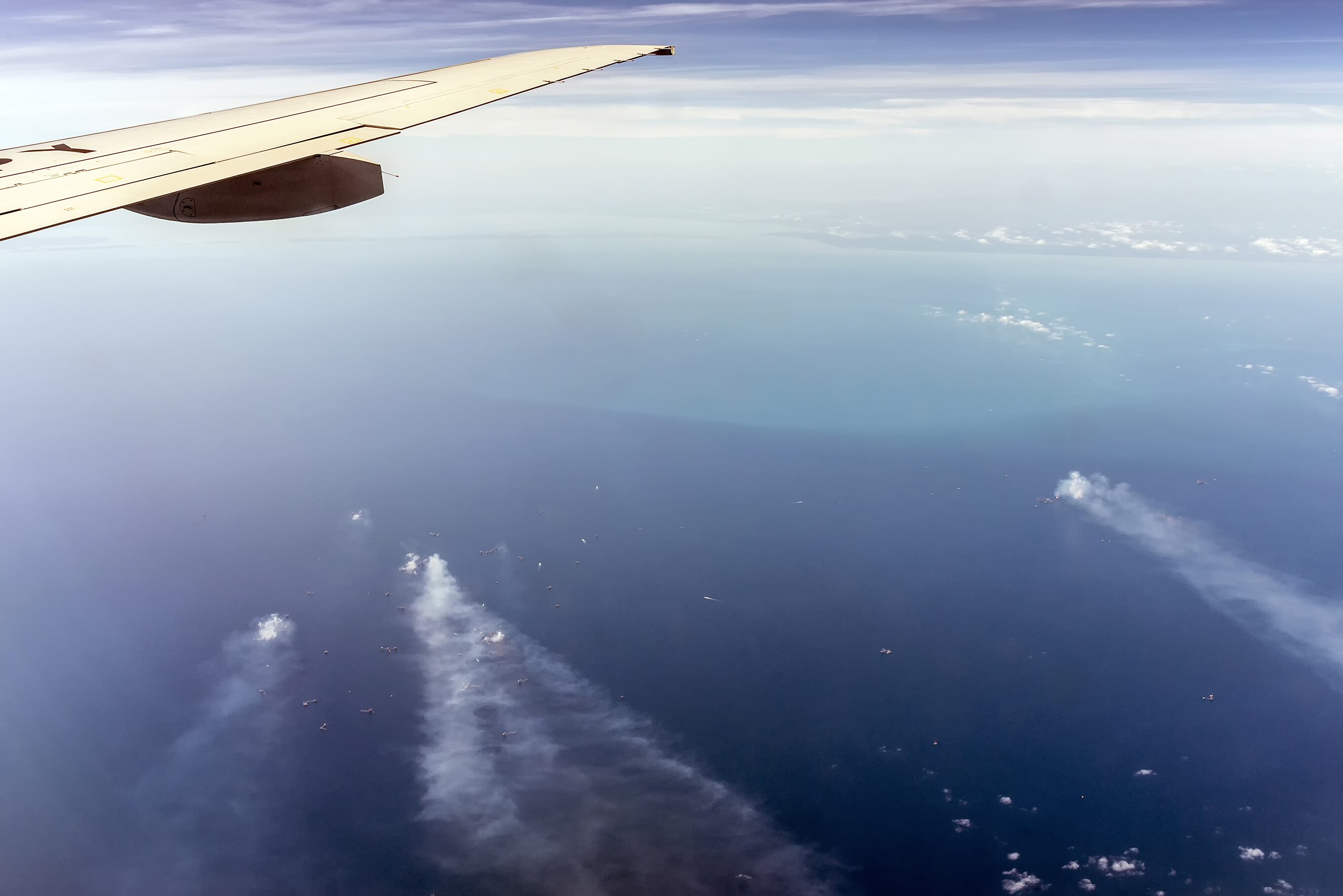 Cantarell Field (2015)
ment could fill it. Later, loading of the crust within the basin and adjacent coastal plain by the accumulation of kilometers of sediments during the rest of the Mesozoic and all of the Cenozoic further depressed the underlying crust to its current position about 10–20 km (6.2–12.4 miles) below sea level. Particularly during the Cenozoic, a time of relative stability for the coastal zones, thick clastic wedges built out the continental shelf along the northwestern and northern margins of the basin.
 Sediment in the Gulf of Mexico
To the east, the stable Florida Platform was not covered by the sea until the latest Jurassic or the beginning of Cretaceous time. The Yucatán Platform was emergent until the mid-Cretaceous. After both platforms were submerged, the formation of carbonates and evaporites has delineated the geologic history of these two stable areas. Most of the basin was rimmed during the early Cretaceous by carbonate platforms, and its western flank was involved during the latest Cretaceous and early Paleogene periods in a compressive deformation episode, the Laramide Orogeny, which created the Sierra Madre Oriental of eastern Mexico.
The Gulf of Mexico is 41% continental slope, 32% continental shelf, and 24% abyssal plain, with the greatest depth of 12,467 feet in the Sigsbee Deep.
Seven main areas are given as:
- Gulf of Mexico basin; contains the Sigsbee Deep.
- Northeast Gulf of Mexico; extends from a point east of the Mississippi River Delta near Biloxi to the eastern side of Apalachee Bay.
- South Florida Continental Shelf and Slope; extends along the coast from Apalachee Bay to the Straits of Florida and includes the Florida Keys and Dry Tortugas.
- Campeche Bank; extends from the Yucatán Straits in the east to the Tabasco–Campeche Basin in the west and includes Arrecife Alacran.
- Bay of Campeche; a bight extending from the western edge of Campeche Bank to the offshore regions east of Veracruz.
- Western Gulf of Mexico; located between Veracruz to the south and the Rio Grande to the north.
- Northwest Gulf of Mexico; extends from Alabama to the Rio Grande.
Brine pools
A number of brine pools, sometimes called brine lakes, are known on the seafloor of the northern half of the Gulf of Mexico. Brine pools in the Gulf of Mexico range from just 1 metre (3 ft 3 in) across to 20 kilometres (12 mi) long. Brine is produced wherever the water of the Gulf comes in contact with the Louann Salt, an evaporite formation from the Jurassic period, along faults or in unconsolidated sediments. The Louann Salt extends under most of the continental shelf around the northern part of the Gulf from west of Florida to Texas. Under the pressure of overlaying sediments, the salt deforms and migrates, a process known as salt tectonics. Masses of salt may rise through overlaying sediments to form salt domes, or may be extruded along the Sigsbee Escarpment where the slope of the continental shelf exposes lower laying stata.
The brines usually exceed 200 parts-per-thousand (ppt) of salt and are 25% or more denser than most seawater (average 35 ppt). The density difference inhibits mixing of the brine with other sea water, and the brine flows downslope and gathers in depressions in the gulf floor. Hydrocarbons and gas hydrates rising from salt diapirs may cause doming of the gulf floor, with the gas sometimes erupting strongly enough to leave a depression in the gulf floor surrounded by a rim, where brine may pool. The East Flower Garden Bank brine pool is in a crater formed by the collapsed cap of a salt dome. The circular pool covers 500 square metres (5,400 sq ft) with a maximum depth of 25 centimetres (9.8 in), and is 70 metres (230 ft) beneath the surface of the Gulf. It is anoxic and contain quantities of hydrogen sulfide and methane.
The brine pool known as GB425, which is 600 metres (2,000 ft) deep, is fed by a mud volcano. The temperature at the surface of the pool can vary from 6 to 48 °C (43 to 118 °F), and is on average 20 °C (68 °F) warmer than normal bottom temperatures. The brine pool known as GC233 is at a depth similar to that of GB425, 650 metres (2,130 ft) deep. The pool sits in a depression at the top of a mound and covers about 190 square metres (2,000 sq ft). Although GC233 has a lower inflow of brine than GB425 and a temperature about 15 °C (59 °F) below that of GB425, the two pools share some similarities, such as a salinity of about 130 ppt, low sulfides, almost no sulfates, and high concentrations of hydrocarbons.
The Orca Basin is 2,100 metres (6,900 ft) deep, and covers about 400 square kilometres (150 sq mi) with a maximum depth of 350 metres (1,150 ft). The large size is the result of the merger of several salt domes. Salinity in the pool increases gradually over a depth of 75 metres (246 ft), and reaches 300 ppt at depth, with zero dissolved oxygen.
A brine pool was discovered in 2014 on the sea floor at a depth of 1,000 meters (3,300 ft) with a circumference of 30 meters (100 ft) and depth of 4 meters (12 ft), which is four to five times saltier than the surrounding water. The site cannot sustain any kind of life other than bacteria, mussels with a symbiotic relationship, tube worms, and certain kinds of shrimp. It has been called the "Jacuzzi of Despair" because it is warmer at 18 °C (65 °F) compared to the surrounding water at 4 °C (39 °F).
Hydrology
Circulation of water in and through the Gulf is part of the larger circulation patterns of the Atlantic Ocean. Water flows into the Gulf from the Caribbean Sea through the Yucatan Channel as the Yucatan Current, and exits to the North Atlanic Ocean through the Florida Straits as the Florida Current, which becomes the Gulf Stream. Movement through the two straits is confined to the upper layers of ocean water, as the Yucatan Strait has a
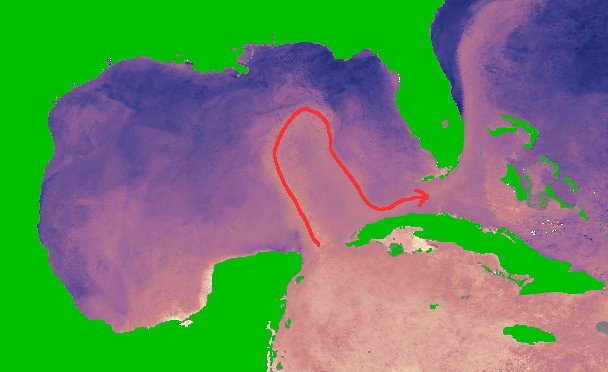 The Loop Current flows northward between Cuba and the Yucatán Peninsula.
maximum depth of only 1,800 metres (5,900 ft), while the Florida Straits has a maximum depth of only 900 metres (3,000 ft).
History
Pre-Columbian
As early as the Maya Civilization, the Gulf of Mexico was used as a trade route off the coast of the Yucatán Peninsula and present-day Veracruz.Spanish exploration
Although the Spanish voyage of Christopher Columbus was credited with the discovery of the Americas by Europeans, the ships in his four voyages never reached the Gulf of Mexico. Instead, the Spanish sailed into the Caribbean around Cuba and Hispaniola. The first alleged European exploration of the Gulf of Mexico was by Amerigo Vespucci in 1497. Vespucci is purported to have followed the coastal land mass of Central America before returning to the Atlantic Ocean via the Straits of Florida between Florida and Cuba. However, this first voyage of 1497 is widely disputed and many historians doubt that it took place as described. In his letters, Vespucci described this trip, and once Juan de la Cosa returned to Spain, a famous world map, depicting Cuba as an island, was produced.
In 1506, Hernán Cortés took part in the conquest of Hispaniola and Cuba, receiving a large estate of land and indigenous slaves for his effort. In 1510, he accompanied Diego Velázquez de Cuéllar, an aide of the governor of Hispaniola, in his expedition to conquer Cuba. In 1518 Velázquez put him in command of an expedition to explore and secure the interior of Mexico for colonization.
In 1517, Francisco Hernández de Córdoba discovered the Yucatán Peninsula. This was the first European encounter with an advanced civilization in the Americas, with solidly built buildings and a complex social organization which they recognized as being comparable to those of the Old World; they also had reason to expect that this new land would have gold. All of this encouraged two further expeditions, the first in 1518 under the command of Juan de Grijalva, and the second in 1519 under the command of Hernán Cortés, which led to the Spanish exploration, military invasion, and ultimately settlement and colonization known as the Conquest of Mexico. Hernández did not live to see the continuation of his work: he died in 1517, the year of his expedition, as the result of the injuries and the extreme thirst suffered during the voyage, and disappointed in the knowledge that Diego Velázquez had given precedence to Grijalva as the captain of the next expedition to Yucatán.
In 1523, a treasure ship was wrecked en route along the coast of Padre Island, Texas. When word of the disaster reached Mexico City, the viceroy requested a rescue fleet and immediately sent Ángel de Villafañe, in Mexico City with Cortés, marching overland to find the treasure-laden vessels. Villafañe traveled to Pánuco and hired a ship to transport him to the site, which had already been visited from that community. He arrived in time to greet García de Escalante Alvarado (a nephew of Pedro de Alvarado), commander of the salvage operation, when Alvarado arrived by sea on July 22, 1554. The team labored until September 12 to salvage the Padre Island treasure. This loss, in combination with other ship disasters around the Gulf of Mexico, gave rise to a plan for establishing a settlement on the northern Gulf Coast to protect shipping and more quickly rescue castaways. As a result, the expedition of Tristán de Luna y Arellano was sent and landed at Pensacola Bay on August 15, 1559.
On December 11, 1526, Charles V granted Pánfilo de Narváez a license to claim what is now the Gulf Coast of the United States, known as the Narváez expedition. The contract gave him one year to gather an army, leave Spain, be large enough to found at least two towns of 100 people each, and garrison two more fortresses anywhere along the coast. On April 7, 1528, they spotted land north of what is now Tampa Bay. They turned south and traveled for two days looking for a great harbor the master pilot Miruelo knew of. Sometime during these two days, one of the five remaining ships was lost on the rugged coast, but nothing else is known of it.
In 1697, Pierre Le Moyne d'Iberville sailed for France and was chosen by the Minister of Marine to lead an expedition to rediscover the mouth of the Mississippi River and to colonize Louisiana which the English coveted. Iberville's fleet sailed from Brest on October 24, 1698. On January 25, 1699, Iberville reached Santa Rosa Island in front of Pensacola founded by the Spanish; he sailed from there to Mobile Bay and explored Massacre Island, later renamed Dauphin Island. He cast anchor between Cat Island and Ship Island; and on February 13, 1699, he went to the mainland, Biloxi, with his brother Jean-Baptiste Le Moyne de Bienville. On May 1, 1699, he completed a fort on the north-east side of the Bay of Biloxi, a little to the rear of what is now Ocean Springs, Mississippi. This fort was known as Fort Maurepas or Old Biloxi. A few days later, on May 4, Pierre Le Moyne sailed for France leaving his teenage brother, Jean-Baptiste Le Moyne, as second in command to the French commandant.

Gulf beach near Sabine Pass

The Mississippi River watershed is the largest drainage basin of the Gulf of Mexico Watershed.

Map of northern part of Gulf of Mexico

The shaded relief map of the Gulf of Mexico and Caribbean area.
Geography
The Gulf of Mexico's eastern, northern, and northwestern shores lie along the US states of Florida, Alabama, Mississippi, Louisiana, and Texas. The US portion of the coastline spans 1,680 miles (2,700 km), receiving water from 33 major rivers that drain 31 states and 2 Canadian provinces. The southwestern and southern shores lie along the Mexican states of Tamaulipas, Veracruz, Tabasco, Campeche, Yucatán, and the northernmost tip of Quintana Roo. The Mexican coastline spans 1,743 miles (2,805 km). On its southeast quadrant, the gulf is bordered by Cuba. It supports major American, Mexican and Cuban fishing industries. The outer margins of the wide continental shelves of Yucatán and Florida receive cooler, nutrient-enriched waters from the deep by a process known as upwelling, which stimulates plankton growth in the euphotic zone. This attracts fish, shrimp, and squid. River drainage and atmospheric fallout from industrial coastal cities also provide nutrients to the coastal zone.
The Gulf Stream, a warm Atlantic Ocean current and one of the strongest ocean currents known, originates in the gulf as a continuation of the Caribbean Current–Yucatán Current–Loop Current system. Other circulation features include a perma-nent cyclonic gyre in the Bay of Campeche, as well as anticyclonic gyres which are shed by the Loop Current and travel westward where they eventually dissipate. The Bay of Campeche constitutes a major arm of the Gulf of Mexico. Additionally, the gulf's shoreline is fringed by numerous bays and smaller inlets. Stream that empty into the gulf include the Mississippi River and the Rio Grande in the northern gulf, and the Grijalva and Usumacinta rivers in the southern gulf. The land that forms the gulf's coast, including many long, narrow barrier islands, is almost uniformly
low-lying and is characterized by marshes and swamps as well as stretches of sandy beach.
The Gulf of Mexico is an excellent example of a passive margin. The continental shelf is quite wide at most points along the coast, most notably at the Florida and Yucatán Peninsulas. The shelf is exploited for its oil by means of offshore drilling rigs, most of which are situated in the western gulf and in the Bay of Campeche. Another important commercial activity is fishing; major catches include red snapper, amberjack, tilefish, swordfish, and various grouper, as well as shrimp and crabs. Oysters are also harvested on a large scale from many of the bays and sounds. Other important industries along the coast include shipping, petrochemical processing and storage, military use, paper manufacture, and tourism.
The gulf's warm water temperature can feed powerful Atlantic hurricanes causing extensive human death and other destruction as happened with Hurricane Katrina in 2005. In the Atlantic, a hurricane will draw up cool water from the depths and making it less likely that further hurricanes will follow in its wake (warm water being one of the preconditions necessary for their formation). However, the gulf is shallower; when a hurricane passes over the water temperature may drop but it soon rebounds and becomes capable of supporting another tropical storm. From 1970 to 2020, surface temperatures warmed at approximately twice the rate observed for the global ocean surface.
The gulf is considered aseismic; however, mild tremors have been recorded throughout history (usually 5.0 or less on the Richter magnitude scale). Earthquakes may be caused by interactions between sediment loading on the sea floor and adjustment by the crust. On September 10, 2006, the U.S. Geological Survey National Earthquake Information Center reported that a magnitude 6.0 earthquake occurred about 250 miles (400 km) west-southwest of Anna Maria, Florida. The quake was reportedly felt from Louisiana to Florida. There were no reports of damage or injuries. Items were knocked from shelves and seiches were observed in swimming pools in parts of Florida. The earthquake was described by the USGS as an intraplate earthquake, the largest and most widely felt recorded in the past three decades in the region. According to the September 11, 2006 issue of The Tampa Tribune, earthquake tremors were last felt in Florida in 1952, recorded in Quincy, 20 miles (32 km) northwest of Tallahassee.
Maritime boundary delimitation agreements
Cuba and Mexico: Exchange of notes constituting an agreement on the delimitation of the exclusive economic zone of Mexico in the sector adjacent to Cuban maritime areas (with map), of July 26, 1976.
Cuba and United States: Maritime boundary agreement between the United States of America and the Republic of Cuba, of December 16, 1977.
Mexico and United States: Treaty to resolve pending boundary differences and maintain the Rio Grande and Colorado River as the international boundary, of November 23, 1970; Treaty on maritime boundaries between the United States of America and the United Mexican States (Caribbean Sea and Pacific Ocean), of May 4, 1978, and treaty on the delimitation of the continental shelf in the western Gulf of Mexico beyond 200 nautical miles (370 km; 230 mi), of June 9, 2000.
On December 13, 2007, Mexico submitted information to the Commission on the Limits of the Continental Shelf (CLCS) regarding the extension of Mexico's continental shelf beyond 200 nautical miles. Mexico sought an extension of its continental shelf in the Western Polygon based on international law, UNCLOS, and bilateral treaties with the United States, in accordance with Mexico's domestic legislation. On March 13, 2009, the CLCS accepted Mexico's arguments for extending its continental shelf up to 350 nautical miles (650 km; 400 mi) into the Western Polygon. Since this would extend Mexico's continental shelf well into territory claimed by the United States, however, Mexico and the U.S. would need to enter a bilateral agreement based on international law that delimits their respective claims.
Shipwrecks
A ship now called the Mardi Gras sank around the early 19th century about 35 mi (56 km) off the coast of Louisiana in 4,000 feet (1,200 m) of water. She is believed to have been a privateer or trader. The shipwreck, whose real identity remains a mystery, lay forgotten at the bottom of the sea until it was discovered in 2002 by an oilfield inspection crew working for the Okeanos Gas Gathering Company (OGGC). In 2007 an expedition led by Texas A&M University and funded by OGGC under an agreement with the Minerals Management Service (now BOEM) was launched to undertake the deepest scientific archaeological excavation ever attempted at that time to study the site on the seafloor and recover artifacts for eventual public display in the Louisiana State Museum. As part of the project educational outreach Nautilus Productions in partnership with BOEM, Texas A&M University, the Florida Public Archaeology Network and Veolia Environmental produced a documentary about the project, short videos and video updates during the expedition. Video footage from the ROV was an integral part of this outreach and used extensively in the Mystery Mardi Gras Shipwreck documentary.
On July 30, 1942, the Robert E. Lee, captained by William C. Heath, was torpedoed by the German submarine U-166. She was sailing southeast of the entrance to the Mississippi River when the explosion destroyed the #3 hold, vented through the B and C decks and damaged the engines, the radio compartment and the steering gear. After the attack she was under escort by USS PC-566, captained by Lieutenant Commander Herbert G. Claudius, en route to New Orleans. PC-566 began dropping depth charges on a sonar contact, sinking U-166. The badly damaged Robert E. Lee first listed to port then to starboard and finally sank within about 15 minutes of the attack. One officer, nine crewmen and 15 passengers were lost. The passengers aboard Robert E. Lee were primarily survivors of previous torpedo attacks by German U-boats. The wreck's location was discovered during the C & C Marine survey that located the U-166. In 2001 the wreck of U-166 was found in 5,000 feet (1,500 m) of water, less than two miles (3.2 km) from where it had attacked Robert E. Lee.
Biota
Various biota include chemosynthetic communities near cold seeps and non chemosynthetic communities such as bacteria and other micro-benthos, meiofauna, macrofauna, and megafauna (larger organisms such as crabs, sea pens, crinoids, demersal fish, cetaceans, and the extinct Caribbean monk seal) are living in the Gulf of Mexico. Recently, resident Bryde's whales within the gulf were classified as an endemic, unique subspecies and making them as one of the most endangered whales in the world. The Gulf of Mexico yields more fish, shrimp, and shellfish annually than the south and mid-Atlantic, Chesapeake, and New England areas combined.
The Smithsonian Institution Gulf of Mexico holdings are expected to provide an important baseline of understanding for future scientific studies on the impact of the Deepwater Horizon oil spill. In Congressional testimony, Dr. Jonathan Coddington, associate director of Research and Collections at the Smithsonian's National Museum of Natural History, provides a detailed overview of the Gulf collections and their sources which Museum staff have made available on an online map. The samples were collected for years by the former Minerals Management Service (renamed the Bureau of Ocean Energy Management, Regulation and Enforcement) to help predict the potential impacts of future oil/gas explorations. Since 1979, the specimens have been deposited in the national collections of the National Museum of Natural History.
Oil spills
According to the National Response Center, the oil industry has thousands of minor accidents in the Gulf of Mexico every year. In June 1979, the Ixtoc I oil platform in the Bay of Campeche suffered a blowout leading to a catastrophic explosion, which resulted in a massive oil spill that continued for nine months before the well was finally capped. This was the largest oil
 Dead zone in the Gulf of Mexico
spill in the Gulf of Mexico to date. On April 20, 2010, the Deepwater Horizon oil platform, located in the Mississippi Canyon about 40 miles (64 km) off the Louisiana coast, suffered a catastrophic explosion; it sank a day and a half later. It was in the process of being sealed with concrete for temporary abandonment, to avoid environmental problems. Although initial reports indicated that relatively little oil had leaked, by April 24 it was claimed by BP that approximately 1,000 barrels (160 m3) of oil per day were issuing from the wellhead, about 1-mile (1.6 km) below the surface on the ocean floor.
On April 29, the U.S. government revealed that approximately 5,000 barrels (790 m3) per day, five times the original estimate, were pouring into the gulf from the wellhead. The resulting oil slick quickly expanded to cover hundreds of square miles of ocean surface, posing a serious threat to marine life and adjacent coastal wetlands and to the livelihoods of Gulf Coast shrimpers and fishermen. Coast Guard Rear Admiral Sally Brice O'Hare stated that the U.S. government will be "employing booms, skimmers, chemical dispersants and controlled burns" to combat the oil spill.
 Deepwater Horizon in flames after the explosion (2010)
Oil drilling platform off Santa Barbara, California in the Gulf of Mexico.
On April 29, the U.S. government revealed that approximately 5,000 barrels (790 m3) per day, five times the original estimate, were pouring into the gulf from the wellhead. The resulting oil slick quickly expanded to cover hundreds of square miles of ocean surface, posing a serious threat to marine life and adjacent coastal wetlands and to the livelihoods of Gulf Coast shrimpers and fishermen. Coast Guard Rear Admiral Sally Brice O'Hare stated that the U.S. government will be "employing booms, skimmers, chemical dispersants and controlled burns" to combat the oil spill. By May 1 the oil spill cleanup efforts were underway but hampered by rough seas and the "tea like" consistency of the oil. Cleanup operations were resumed after conditions became favorable. On May 27 the USGS had revised the estimate of the leak from 5,000 barrels per day (790 m3/d) to 12,000–19,000 barrels per day (3,000 m3/d) an increase from earlier estimates. On July 15 BP announced that the leak had stopped for the first time in 88 days. In July BP reached an $18.7bn settlement with the U.S. government, the states of Alabama, Florida, Louisiana, Mississippi and Texas, as well as 400 local authorities. To date, BP's cost for the clean-up, environmental and economic damages and penalties has reached $54bn.
On May 12, 2016, a release of oil from subsea infrastructure on Shell's Brutus oil rig released 2,100 barrels of oil. This leak created a visible 2 by 13 miles (3.2 by 20.9 km) oil slick in the sea about 97 miles (156 km) south of Port Fourchon, Louisiana, according to the U.S. Bureau of Safety and Environmental Enforcement.
Wikipedia: xxx
Update: 04. + 07.03.2024/19.02.2026/xx
Quelle: https://en.wikipedia.org/wiki/Gulf_of_Mexico